admin_Deidre – StomaCare Supplies

The First 48 Hours at Home: A Gentle Guide to Your New Beginning

The First 48 Hours at Home: A Gentle Guide to Your New Beginning

You’ve just pulled into your driveway. You are back from the hospital. For the last week or two, you’ve been surrounded by doctors, blinking monitors, and nurses who changed your stoma bag with practiced, effortless ease. But now, you are standing in your own hallway. The front door is closed. The “hospital bubble” has burst.

Suddenly, your own bathroom feels very different.

It is completely normal if your hands are shaking a little right now. Walking through your front door after ostomy surgery is a deeply emotional milestone. It’s the moment the reality hits you: This is my new normal. You might feel incredibly grateful to be alive, but terrified of the next time your bag fills up.

Please take a breath. Look at yourself in the mirror and give your body some grace. You have been through a major battlefield, and you are still standing. You can do this. Let’s walk through your first 48 hours at home together, step by step.

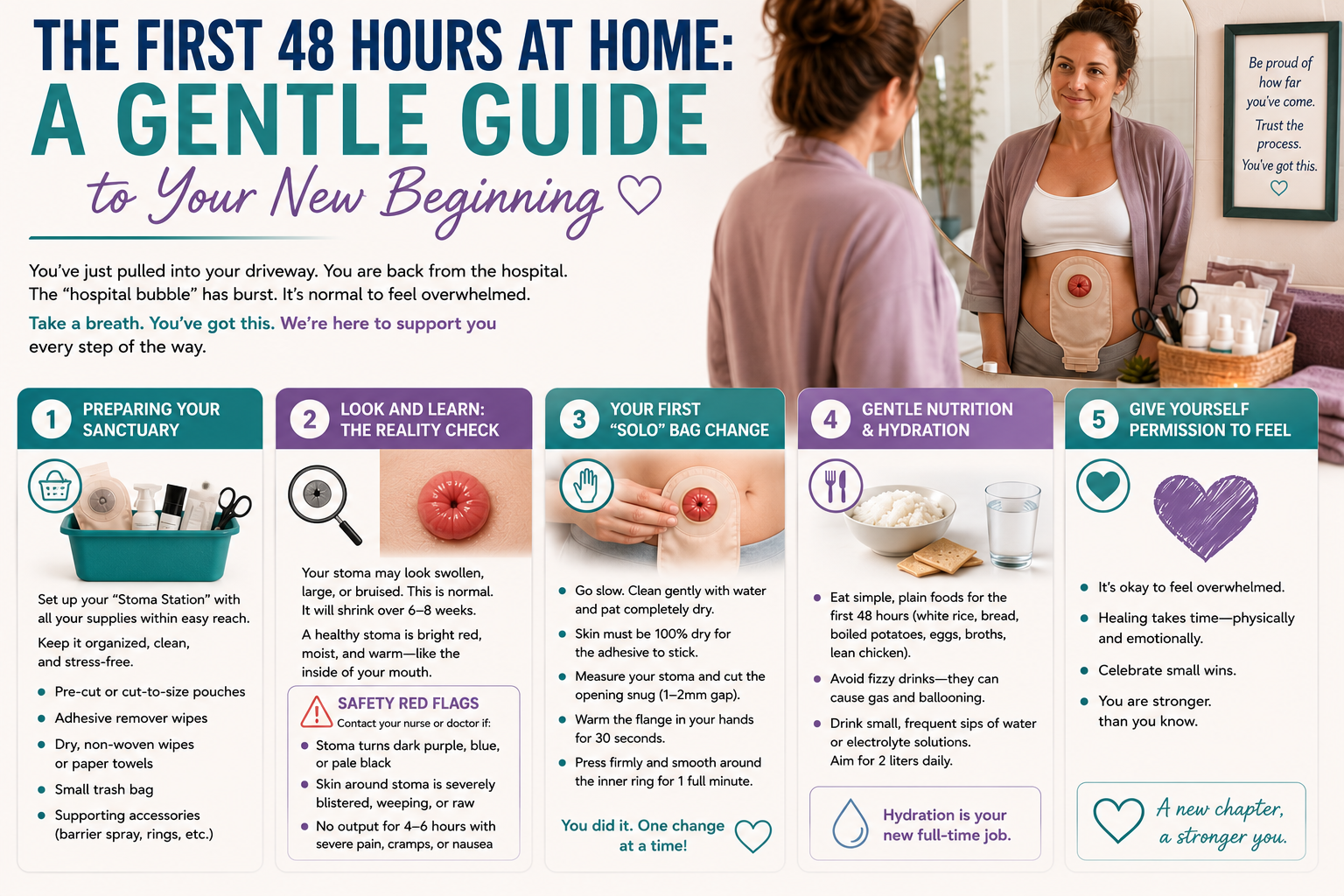
  1. Preparing Your Sanctuary

Before you even think about changing your appliance, you need to set up your environment. In the hospital, everything was handed to you on a clean plastic tray. At home, confusion breeds panic. If you experience a leak at 2 AM, the last thing you want to do is hunt through random cupboards for a pair of scissors.

Turn your bathroom into a stress-free zone. Clear off a specific shelf or place a clean, dedicated basket next to the sink. This is your “Stoma Station.”

Pack it with your daily essentials:
  • Your pre-cut or cut-to-size pouches.
  • Medical adhesive remover wipes (to pull the bag off gently).
  • Dry, non-woven wipes or basic paper towels (standard toilet paper shreds too easily when wet).
  • A small trash bag for disposal.
  • Your supporting accessories (like barrier sprays or moldable rings).
  1. Look and Learn: The Reality Check

When you sit down to do your first bag change at home, you are going to look directly at your stoma. It might look different than it did a few days ago.

Right now, your stoma is likely still swollen from the trauma of surgery. It might look quite large, bruised, or a bit prominent. That is completely okay. Over the next six to eight weeks, that swelling will steadily go down, and your stoma will shrink into its permanent size.

Remember what we talked about in the hospital: a healthy stoma should look bright red, moist, and warm. It looks like the inside of your mouth. It has no nerve endings, so when you touch it to clean it, it will not hurt. You might see a tiny speck of blood on your wipe when cleaning it—don’t panic. The tissue is delicate, like gums when you floss.

The Safety Red Flags

While change is normal, look out for these three signs. Contact your stoma nurse or doctor immediately if:

  • Your stoma turns a dark purple, blue, or pale black color (this means the blood supply is compromised).
  • The skin around the stoma becomes severely blistered, weeping, or raw.
  • You have absolutely no output for more than 4 to 6 hours, accompanied by severe abdominal pain, cramps, or nausea (this points to a food blockage).
  1. Your First “Solo” Bag Change

The house is quiet. It’s time to change the bag by yourself for the first time.

First, gather your thoughts. If your stoma is highly active, try to time your change for first thing in the morning before you eat or drink anything, as this is when the bowel is usually sleepiest.

Take your time. Peel the old pouch off slowly from top to bottom while pressing down gently on the surrounding skin with your other hand. Clean the area with plain water.

Now, here is the golden rule of stoma care: Skin health is entirely dependent on dryness. If your skin is even slightly damp when you apply the new baseplate, the adhesive will fail, output will leak, and your skin will burn. Pat the area completely dry with a paper towel.

Because your stoma is still changing shape, use your measuring guide card to check the size before you cut the baseplate hole. It should fit snugly around the base of the stoma like a collar, leaving no more than a 1–2mm gap of exposed skin.

Before you press it to your body, warm the sticky flange between your hands for 30 seconds. Your body heat activates the medical adhesive, ensuring a bulletproof seal. Press it down firmly, smoothing your fingers around the inner ring for a full minute.

You did it. Your first solo change is complete.

  1. Gentle Nutrition for the First Days

Your digestive tract has been rearranged and handled by a surgeon. It needs a soft, easy landing.

For these first 48 hours at home, keep your meals plain and boring. Think of it as a “white palette” diet. Stick to white bread, plain white rice, boiled potatoes, soft eggs, clear broths, and lean chicken. Avoid carbonated fizzy drinks, which will instantly inflate your bag with gas like a balloon.

Hydration is your new full-time job. When you lose a portion of your bowel, your body processes water differently. Drink small, frequent sips of water or electrolyte solutions throughout the day. Aim for 2 liters. Don’t chug large glasses of water all at once, as this can actually flush through your system too quickly and cause dehydration.

  1. Give Yourself Permission to Feel

Lastly, remember to look after your heart.

You might look at your reflection today and cry. You might feel a profound sense of grief for the body you had before surgery. That is not weakness; it is human. It takes time for your mind to catch up with the physical changes your body has endured.

Celebrate the small victories. Did you empty the bag on your own today? That is a win. Did you look at the stoma without turning away? That is progress.

You are going to get through this transition. Step by step, change by change, your confidence will return. And remember, you don’t have to walk this road in isolation.

Need a Helping Hand?

If you are feeling unsure about your stoma size, if your skin is starting to sting, or if you simply want a professional to verify that your appliance fits perfectly, we are here for you.

At StomaCare Supplies, we ship discreet care packages nationwide and offer private virtual consultations. Click the button below to download our Free Home-Care Transition Checklist, or send our team a WhatsApp message right now. We will guide you through every single step.
 

What is a Colostomy

Procedure overview

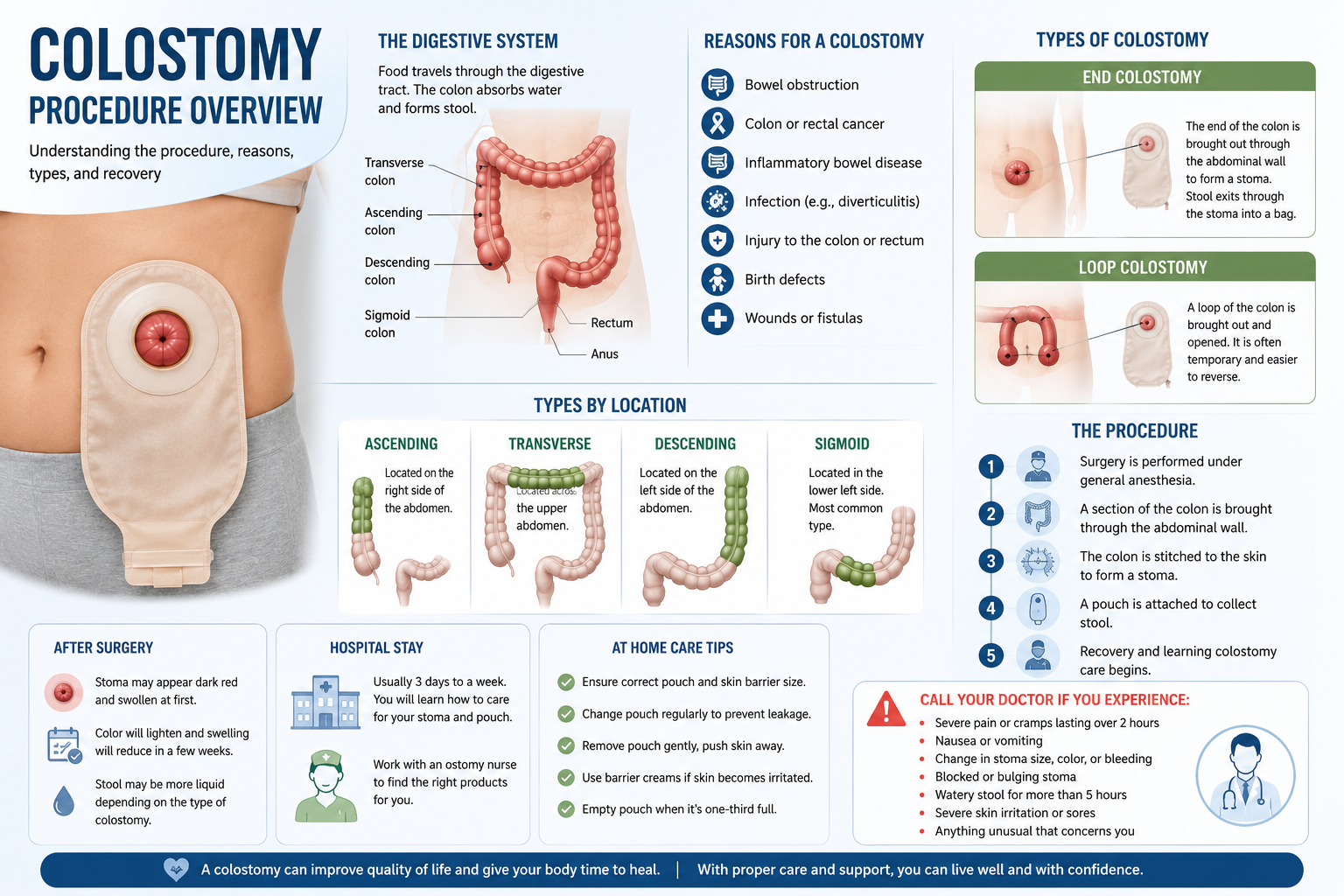
A colostomy is an operation that creates an opening for the colon, or large intestine, through the abdomen. A colostomy may be temporary or permanent. It is usually done after bowel surgery or injury. Most permanent colostomies are “end colostomies,” while many temporary colostomies bring the side of the colon up to an opening in the abdomen.

During an end colostomy, the end of the colon is brought through the abdominal wall, where it may be turned under, like a cuff. The edges of the colon are then stitched to the skin of the abdominal wall to form an opening called a stoma. Stool drains from the stoma into a bag or pouch attached to the abdomen. In a temporary “loop colostomy,” a hole is cut in the side of the colon and stitched to a corresponding hole in the abdominal wall. This can be more easily reversed later by simply detaching the colon from the abdominal wall and closing the holes to reestablish the flow of stool through the colon.

Reasons for the procedure

Colostomy surgery may be needed to treat several different diseases and conditions. These include:

  • Birth defect, such as a blocked or missing anal opening, called an imperforate anus
  • Serious infection, such as diverticulitis, inflammation of little sacs on the colon
  • Inflammatory bowel disease
  • Injury to the colon or rectum
  • Partial or complete intestinal or bowel blockage
  • Rectal or colon cancer
  • Wounds or fistulas in the perineum. A fistula is an abnormal connection between internal parts of the body, or between an internal organ and the skin. A woman’s perineum is the area between her anus and vulva; a man’s lies between his anus and scrotum.

The reason for the colostomy helps the healthcare provider decide whether it will be short-term or permanent. For example, some infections or injuries require giving the bowel a temporary rest, then reattaching it. A permanent colostomy may be required for a more serious or incurable problem, such as cancer that requires removal of the rectum, or a failure of the muscles that control elimination.

How the digestive system works

A colostomy won’t change the way your digestive system works. Normally, after you chew and swallow your food, it goes through your esophagus, or swallowing tube, into your stomach.

From there, it travels to your small intestine and then to your large intestine, or colon. Hours or days later, the indigestible residue leaves the storage area of your rectum via your anus, as stool. Stool typically stays loose and liquid during its passage through the upper colon. There, water is absorbed from it, so the stool gets firmer as it nears the rectum.

The ascending colon goes up the right side of your body. The stool here is liquid and somewhat acidic, and it contains digestive enzymes. The transverse colon goes across your upper abdomen, and the descending and sigmoid colon go down the left side of your body to your rectum. In the left colon, the stool becomes progressively less liquid, less acidic, and contains fewer enzymes.

Where your colon is interrupted determines how irritating to the skin your stool output will be. The more liquid the stool, the more important it will be to protect your abdominal skin after a colostomy.

Risks of the procedure

Getting a colostomy marks a big change in your life, but the surgery itself is uncomplicated. It will be performed under general anesthesia, so you will be unconscious and feel no pain. A colostomy may be done as open surgery, or laparoscopically, via several tiny cuts.

As with any surgery, the main risks for anesthesia are breathing problems and poor reactions to medications. A colostomy carries other surgical risks:

  • Bleeding
  • Damage to nearby organs
  • Infection

After surgery, risks include:

  • Narrowing of the colostomy opening
  • Scar tissue that causes intestinal blockage
  • Skin irritation
  • Wound opening
  • Developing a hernia at the incision

Before the procedure

If possible, be sure to discuss your surgical and postsurgical options with a doctor and an ostomy nurse (a nurse who is specially trained to help colostomy patients) before surgery. And, before or after your surgery, you may wish to attend an ostomy support group.

During the procedure

Depending on why you need a colostomy, it will be made in one of 4 parts of the colon: ascending, transverse, descending, or sigmoid.

  • A transverse colostomy is performed on the middle section of the colon, and the stoma will be somewhere across the upper abdomen. This type of surgery–often temporary–is typically performed for diverticulitis, inflammatory bowel disease, cancer, blockage, injury or a birth defect. In a transverse colostomy, the stool leaves the colon through the stoma before reaching the descending colon. Your stoma may have one or two openings. One opening is for stool. The second possible stoma is for the mucus that the resting part of your colon normally keeps producing. If you have only one stoma, this mucus will pass through your rectum and anus.
  • An ascending colostomy goes on the right side of your abdomen, leaving only a short part of the colon active. It is generally performed only when blockage or severe disease prevents a colostomy further along the colon.
  • A descending colostomy goes on the lower left side of the abdomen, while a sigmoid colostomy–the most common type–is placed a few inches lower.

After the procedure

You may be able to suck on ice chips on the same day as your surgery. You’ll probably be given clear fluids the next day. Some people eat normally within two days after a colostomy.

A normal stoma is moist and pink or red colored. When you first see your colostomy, it may appear dark red and swollen, with bruises. Don’t worry. Within a few weeks, the color will lighten and bruises should disappear.

The bandage or clear pouch covering your colostomy right after surgery probably won’t be the same type that you’ll use at home. Your colostomy will drain stool from your colon into this colostomy pouch or bag. Your stool will probably be more liquid than before surgery. Your stool consistency will also depend on what type of colostomy you have and how much of your colon is still active.

In the hospital

A colostomy requires a hospital stay of about 3 days to a week. Your stay will probably be longer if the colostomy was performed for an emergency. During your hospital stay, you’ll learn to care for your colostomy and the appliance or pouch that collects your stool.

Our nurse will show you how to clean your stoma. After you go home, you’ll do this gently every day with warm water only. Then gently pat dry or allow the area to air dry. Don’t worry if you see a little bit of blood.

Use your time in the hospital to learn how to care for your colostomy. If you have an ascending or transverse colostomy, you will need to wear a slim, lightweight, drainable pouch at all times. There are many different types of pouches, varying in cost and made from odor-resistant materials.

Some people with a descending or sigmoid colostomy can eventually learn to predict when their bowels will move and wear a pouch only when they expect a movement. They may also be able to master a process called irrigation to stimulate regular, controlled bowel movements.

Before going home, be sure to talk with an ostomy nurse or other expert who can help you try out the equipment you’ll need. What works best will depend on what type of colostomy you have; the length of your stoma; your abdominal shape and firmness; any scars or folds near the stoma; and your height and weight.

Sometimes, the rectum and anus must be surgically removed, leaving what’s called a posterior wound. In the hospital, you’ll use dressings and pads to cover this wound, and you may also take sitz baths–shallow, warm-water soaks. Ask your doctor and nurse how to care for your posterior wound until it heals. If problems should occur, please contact your doctor. 

At home

The skin around your stoma should look the same as elsewhere on your abdomen. Exposure to stool, especially loose stool, can be irritating. Here are some tips to protect your skin:

  1. Make sure your pouch and skin barrier opening are the right size.
  2. Change the pouch regularly to avoid leakage and skin irritation. Don’t wait until your skin begins to itch and burn.
  3. Remove the pouching system gently, pushing your skin away instead of pulling.
  4. Barrier creams may be used if the skin becomes irritated despite these measures.

Notify your doctor to report any of the following:

  • Cramps that last more than two hours
  • Continuous nausea or throwing up
  • Bad or unusual odor for more than a week
  • Change in your stoma size or color
  • Blocked or bulging stoma
  • Bleeding from the stoma opening or in the pouch
  • Wound or cut in the stoma
  • Serious skin irritation or sores
  • Watery stool for more than five hours
  • Anything unusual that concerns you

A good rule is to empty your pouch when it’s one-third full. And be sure to change the pouch before it leaks. As a general rule, change it no more than once a day, but not less than every three or four days

0
    0
    Your Cart
    Your cart is emptyReturn to Shop